What a Japanese auction sheet is
An auction sheet, called オークションシート or 出品票 (shuppin-hyō) in Japan, is written by the auction house's inspector before the sale. Dealers bidding from another city or another country rely on it to judge cars they cannot see. For a buyer abroad, it is usually the most detailed independent record of the car's condition before export.
There is one sheet per sale. A car auctioned twice has two sheets, and they can show different grades and mileage. Layouts differ between houses such as USS, TAA, JU, CAA, HAA and Aucnet, and some sheets are filled in by hand, but the same blocks appear on almost all of them.
Auction sheet layout, block by block
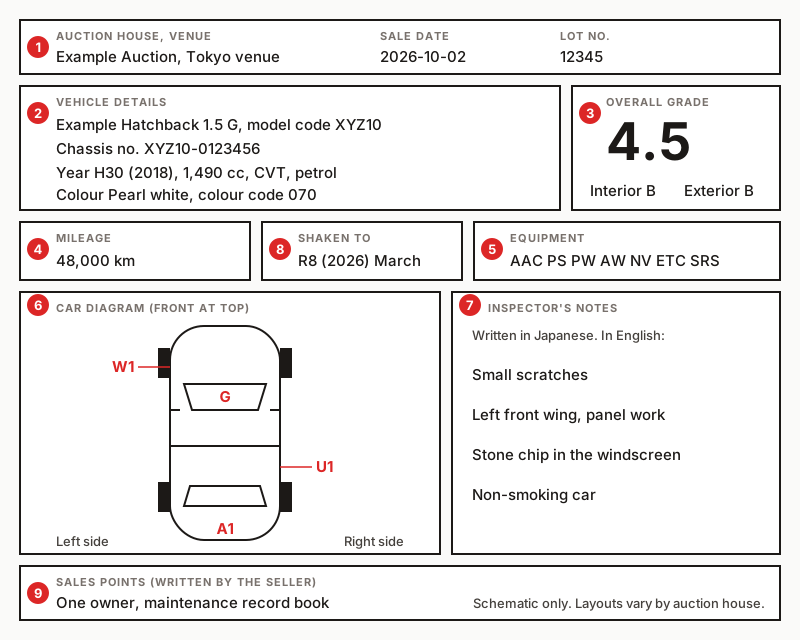
| No. | Block | What it shows | What to check |
|---|---|---|---|
| 1 | Header | Auction house, venue, sale date and lot number. | Note them. They tie the sheet to one sale. |
| 2 | Vehicle details | Model and trim, model code, chassis number, year, engine size, transmission, fuel, colour and colour code. | The chassis number and colour should match the car. |
| 3 | Grade box | Overall grade and interior letter, and at some houses an exterior letter. | Read the number and the letter together. |
| 4 | Mileage | Odometer reading in kilometres, sometimes with a note that the meter was replaced or the mileage is unknown. | Compare with earlier readings for the same chassis number. |
| 5 | Equipment | Abbreviations for fitted options. | Compare with what the car has now. |
| 6 | Car diagram | An outline of the car with damage codes where the inspector found something. | Match each code with the notes and the photos. |
| 7 | Inspector's notes | Japanese text on condition, repairs, rust, smells and faults. | Get them translated. They often hold the key detail. |
| 8 | Inspection date | When the Japanese roadworthiness inspection (車検, shaken) runs out, and sometimes the first registration date. | Helps confirm the car's age and history. |
| 9 | Sales points | Comments from the selling dealer, such as one owner or service records. | These are the seller's claims, not the inspector's. |
How to read an auction sheet, step by step
Find the auction house, date and lot number
They are in the header. Without them the sheet cannot be traced to a sale.
Match the chassis number
Compare the chassis number on the sheet with the plate on the car and its documents, character by character. Some online copies hide part of the serial. See how to find the chassis number.
Work out the year
Convert a Japanese era year if needed. H30 is 2018 and R2 is 2020.
Read the grade and the interior letter
For example, 4/B is a good car with a clean, lightly used interior. The full scale is in Japanese auction grades explained.
Check the mileage
Read the odometer figure and any note about it, then compare it with other recorded readings.
Decode the car diagram
Read the letter, number and position of each code using the code table below.
Translate the notes
Match each note to a code, and look for what the diagram cannot show: rust underneath, flood, smells, warning lights or modifications.
Check the equipment and colour
Compare the options and colour code with the car in front of you. A different colour can mean a repaint.
Compare the copy with the original record
Check that grade, mileage, date and marks agree with the original auction record for the chassis number.
Auction sheet damage codes
Each mark on the diagram is a letter for the type of defect and usually a number for its size: 1 is small or light, 2 is medium and 3 is large or heavy. A2 on a door is a medium scratch on that door. The table lists the codes most legends share. Where houses use a letter differently, the notes column says so.
| Code | Meaning | Notes |
|---|---|---|
| A1, A2, A3 | Scratch, from small to large | The most common mark. |
| U1, U2, U3 | Dent, from small to large | Size limits differ by house. |
| B1, B2, B3 | Dent with a scratch | Used on many legends. |
| E1, E2, E3 | Dimples or small dents, from few to many | Used on some legends only. |
| W1, W2, W3 | Wavy panel, a sign of repair or filler, from barely visible to obvious | Points to bodywork even when there is no repair grade. |
| S1, S2 | Rust, from some to heavy | Some legends swap S and C or use one letter for both. |
| C1, C2 | Corrosion, from some to heavy | See S. |
| P | Paint damage or a repainted area | Meaning varies by house. |
| H | Faded paint | Used on some legends. |
| X | Panel needs replacing | On glass, some legends use X for a crack that needs a new windscreen. |
| XX | Panel has been replaced | A replaced bolt-on panel does not make the car R or RA on its own. |
| Y1, Y2, Y3 | Hole or crack, from small to large | Sources differ on whether Y covers panels, bumpers or lights. |
| G | Stone chip in the glass | Usually on the windscreen. |
| R or RX on glass | Repaired crack in the glass, or a repaired crack that still needs replacing | Not the same as an R grade. |
| Arrows, circles, Japanese words | Point to a part or add detail | Read with the notes. |
Size limits differ by house. Some legends define a size in centimetres or by comparison with a coin or a card. We do not give measurements because they are not shared between houses. Each code is covered in more depth in auction sheet codes decoded.
Japanese words in the inspector's notes
The notes are where the inspector writes what the codes cannot show. They are often handwritten and abbreviated, and photo translation apps misread them. These words come up often and are worth knowing on sight.
| Japanese | Reading | Meaning |
|---|---|---|
| 修復歴 | shūfuku-reki | Repair history (repaired frame or structure) |
| 交換 | kōkan | Replaced |
| 板金 | bankin | Panel beating, bodywork |
| 塗装 | tosō | Paint, painted |
| キズ (傷) | kizu | Scratch |
| ヘコミ (凹) | hekomi | Dent |
| サビ (錆) | sabi | Rust |
| 腐食 | fushoku | Corrosion |
| 割れ | ware | Crack |
| 冠水 | kansui | Flooded |
| 雹害 | hyōgai | Hail damage |
| メーター交換 | mētā kōkan | Odometer (meter) replaced |
| 走行不明 | sōkō fumei | Mileage unknown |
| 改造 | kaizō | Modified |
| 異音 | i-on | Unusual noise |
| オイル漏れ | oiru more | Oil leak |
| 警告灯 | keikokutō | Warning light |
| タバコ臭 | tabako-shū | Cigarette smell |
| 焦げ穴 | kogeana | Burn hole, often from a cigarette |
| シミ | shimi | Stain |
| 禁煙車 | kin'ensha | Non-smoking car |
| 記録簿 | kirokubo | Maintenance record book |
| ワンオーナー | wan ōnā | One owner |
Ask for the Japanese original, not only a typed English version. A translation can be changed even when the original is genuine, and a person who reads Japanese will catch abbreviations that software misses.
Equipment codes and other abbreviations
- AT, MT, CVT
- Automatic, manual and continuously variable transmission.
- AC, AAC
- Air conditioning, and automatic climate control.
- PS, PW
- Power steering and power windows.
- SR
- Sunroof.
- AW
- Alloy wheels.
- NV, TV
- Navigation system and television.
- ETC
- Reader for Japan's electronic toll cards. It has no use outside Japan.
- ABS, SRS
- Anti-lock brakes and airbags.
- 2WD, 4WD
- Two-wheel and four-wheel drive.
- Year in H or R
- Japanese years use the era name. H is Heisei (H1 is 1989, so H30 is 2018) and R is Reiwa (R1 is 2019, so R2 is 2020). 2019 appears as H31 or R1. Older cars may show S for Showa. Some sheets also show the Western year.
- Colour code
- The manufacturer's paint code. It should match the code on the car's plate.
How sheets differ between USS, TAA, JU, CAA, HAA and Aucnet
Each house prints its own design. USS sheets show the overall grade with separate interior and exterior letters. JU sheets can vary between regional venues. Aucnet works online, with cars inspected at the selling dealer's premises and a report that leans on photos and typed notes. The blocks in this guide appear on all of them, in different places.
A layout that looks unfamiliar is not a warning sign by itself. A layout that does not match the house named on it is. Read the legend for the house before reading the codes, and see Japanese car auction houses explained for more on each house.
A worked example
Take the sample sheet above. The header gives the auction house, the sale date and lot 12345, which together point to one sale. The vehicle block shows a car from H30, which is 2018, with chassis number XYZ10-0123456 and colour code 070.
The grade box reads 4.5 with interior B: a very good car with a clean, lightly used cabin. The mileage is 48,000 km with no note about the meter.
The diagram shows A1 on the rear bumper, U1 on the right rear door, W1 on the left front wing and G on the windscreen. That is a small scratch, a small dent, a lightly repaired wing and a stone chip, which fits a 4.5. The notes repeat the scratches, the panel work on the left front wing and the chip, and record a non-smoking car. The seller's sales points add one owner and a record book, which are claims to check, not findings.
Before relying on the sheet, match the chassis number and colour code to the car, and compare this copy with the original record for that chassis number.
How to spot a fake or altered auction sheet
Most sheets are genuine. The ones that are not are usually altered copies: a grade raised from R to 4, a mileage figure changed, the notes cut off, or a sheet from another car or an earlier sale. These are the signs worth checking.
- The header is cropped, or the auction house, date or lot number is missing.
- The chassis number is missing, partly hidden, or does not match the car.
- Digits in the grade or mileage boxes look different from the rest: another font, sharper or blurrier, out of line, or on a patch of different background.
- The layout does not match the house named on the sheet.
- The grade does not fit the diagram, such as a 4.5 with XX and W2 marks on several panels.
- The mileage does not fit the wear on the seats, pedals and steering wheel, or is lower than an earlier recorded reading.
- The colour on the sheet differs from the car. That can be an honest repaint, or a sign the sheet belongs to another car.
- You are offered only an English "translated sheet", not the Japanese original.
- The sale date does not fit the car's year or its export date.
None of these proves a fake by itself, and a missing record does not prove one either: some cars never went through an auction, and not every record is held. The firm check is the original record. See how to tell if a Japanese auction sheet is real for a step-by-step method.
A CarTrust report shows the original auction sheet and auction photos when they are recorded for the chassis number, along with accident, damage and theft history, recalls and more. Mileage history is in the Silver and Gold reports, not Bronze. See the sample report and what each report includes.
What an auction sheet does not show
- Anything after the auction date, including damage in transit and repairs abroad.
- Mechanical condition and servicing, beyond what the inspector notes.
- Earlier or later sales of the same car, which have their own sheets.
- Repairs the inspector could not see.
- Mileage after the sale. See how to spot mileage tampering.
Auction sheet, export inspection and history report
The three are often confused. The auction sheet records the car's condition on the day it was sold in Japan. A pre-shipment inspection, which some importing countries including Kenya require, checks the car against that country's rules before it is shipped. See pre-shipment inspection from Japan.
A vehicle history report gathers records for one chassis number over time, such as auction sales, accident, damage and theft records, recalls and mileage readings. It shows whether the sheet you were given matches the record. See checking a Japanese car's history.